

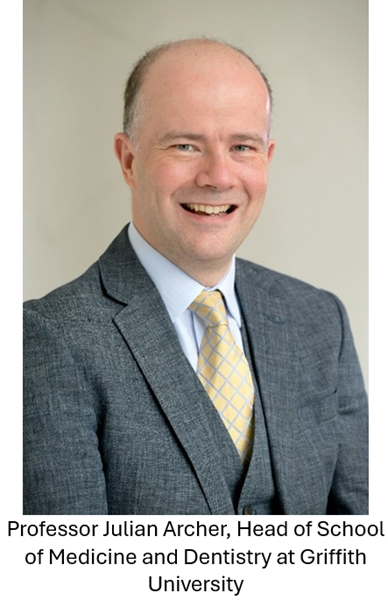
Head of the School of Medicine and Dentistry at Griffith University, Professor Julian Archer, did not always believe in qualitative research in the way he does now. In fact, Professor Archer’s PhD was written using a purely quantitative generalisability theory and was heavily entrenched in statistics. Now, however, he describes himself as a mixed methods researcher. This is one of the many aspects Prof Archer revealed to me when we met recently to discuss his involvement in a 2019 study titled, ‘Comparing psychiatric care experiences shared online with validated questionnaires: do they include the same content?’
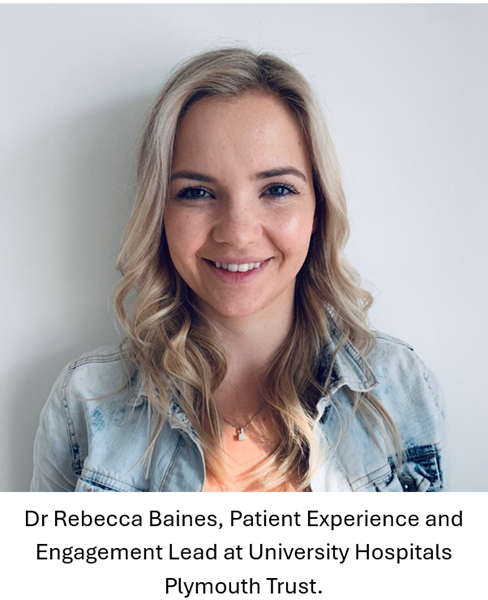
The study originated when, at the time, Prof Archer was co-supervising Dr Rebecca Baines's PhD in the UK. Their research examined how patient stories inform care and was based in a psychiatric setting where the views of those experiencing mental ill health have historically been viewed through a lens of unreliability. Philosopher Miranda Fricker describes this as testimonial injustice, where the testimony of a marginalised group is discounted because of prejudice about their credibility - and it makes patient reported experience data from these cohorts all the more complex. This complexity, however, is precisely what drew Dr Baines's and Prof Archer's interest.
Their study finds that the patient-reported experience measures used in psychiatric hospital settings tended to measure different outcomes from what mental health patients would write about in their stories. Not only would patients discuss their care journey across multiple clinicians - something that surveys are generally poor at capturing - but they would also discuss entirely different aspects of care quality. The question this raises is: who are patient questionnaires really for?
It is a question that arises whenever a standardised measurement tool is used to gather information. As Prof Archer and I discussed, even randomised controlled trials only include a small portion of the population because people with chronic health issues or other life limitations are often excluded from participating.
One could argue this exclusion creates an almost ‘standard patient’ dilemma - an overly sanitised and somewhat beige outlook on humanity - and, as Prof Archer says, "you effectively are removing life."
How, then, do we truly capture lived experience, something that is widely agreed to be essential for a domain of work centred entirely around the lives of those experiencing health and care?
The answer is not always clear and, alas, no silver bullet was discovered in our discussion. However, what we did agree upon was the very necessity of hearing the richness that patient stories carry within them. Whilst the questionnaires and quantitative methods that are currently so central to healthcare are important, so too are stories.
It is for this reason that, when I spoke with Prof Archer, he put it in this way:
"When I say the word data, I mean numbers and words... and we don't talk in numbers, we talk in words."
This natural and intrinsic way that we make meaning - through speaking of our experiences and using words rather than numbers - is how we understand the world. It is us speaking through our humanity, with all the messiness that our existence inherently entails, standing in antithesis to Murdochian dryness.
As to what else can be missed when relying on surveys alone, Prof Archer said:
"If you're using a questionnaire and you prove that an aspect rates as two out of five and another as four out of five, you know that one aspect is ‘better’ than the other, but it doesn't tell you anything much about that. It doesn't tell you why or what you might do about it and what needs to change. It's the words that follow that allow you to actually do that. So, in this sort of work, it's the words that matter."
Even though words and stories do provide us with greater richness, their struggle to lend themselves to quantification is one that has historically limited their use in healthcare settings.
Yet, looking to the future, Prof Archer believes that "with AI and new ways of managing large amounts of free text, we've actually got a potential solution to a problem that we were trying to avoid before." As these systems mature and take wing, there arises greater opportunity for qualitative stories to play a much larger, even equal, role in patient-reported experience.
And I believe we have every reason to incorporate these voices.
As Prof Archer and Dr Baines’s study writes, "The personal, subjective and human nature of patient experience is not a barrier to use but its strength."
It is in this subjectivity that we can understand why an Indigenous Australian found that staff lacked care and concern, or alternatively why they felt welcomed. We can understand what an elderly patient might feel when receiving stitches for the first time in their life. It is through the experiences of others, through their words and their perspectives, that new areas are brought to life - areas that are often, and may never be, captured in a standardised survey.
By utilising both quantitative PREMs as well as narrative storytelling, we can finally shape patient feedback around what patients are actually wanting to tell us. We can arrive at last to a truly patient-centred feedback system, one where patient feedback is wholly for the patient.
This is the duality – this mixed methodology that Professor Julian Archer has found himself drawn to - which we too should be directing our attention. Perhaps it is in this integration that patient feedback can finally strike the balance it has long since been missing.
Who is patient feedback for?
Who is patient feedback for? https://www.careopinion.org.au/resources/blog-resources/1-images/ade830485c714447b87a6a2a7f4bdfd9.png Care Opinion Australia +617 3354 4525 https://www.careopinion.org.au /content/au/logos/co-header-logo-2020-default.pngUpdate from Care Opinion Australia
Posted by Ellen McGovern-Greco, Moderation and Reporting Officer, Care Opinion Australia, on




Thanks for your feedback.