

Balancing qualitative with quantitative data can be a difficult tightrope to walk. At Care Opinion, we often face the challenge of marrying both the stories we receive with the discrete boundaries that numbers and Likert scales grant us. We are often left asking: how do we walk that line?
I recently sat down and discussed this dilemma with Northern Ireland-based co-founder of Indicaretor, Chris Hawthorne, who seems to have found that balance.
Chris Hawthorne holds a PhD in biomedical informatics and has spent much of the last two years working on applying natural language processing and AI to Care Opinion data, supported by Momentum One Zero, an innovation centre at Queen's University Belfast. The work of Momentum One Zero is to bridge an innovation gap. They function as business-led that brings together interdisciplinary academic research and combine it with real-world challenges.
Their work joined up with Care Opinion and the Public Health Agency, when the Health and Social Care Regulator in Northern Ireland, the Regulation and Quality Improvement Authority (RQIA) became interested in how they could use patient data to support improving outcomes using AI. RQIA wanted to see if they could catch early warning signals from patient experiences before, as Chris put it, “before they snowball into something much bigger”.
This work has become a child of sorts to Chris, who has dedicated roughly two years to this project. Even in Australia, the benefit of such an enterprise is hard to ignore. We know that stories already locate patient safety and quality issues that would otherwise go unnoticed or unresolved (Gillespie and Reader). To do this successfully, NLP systems are often used to trawl through large amounts of text and locate these early warning passages within patient stories.
Indicaretor’s advantage is that it is much simpler to use.
When Chris showed me the dashboard, it displayed multiple graphs measuring the different domains of quality of care. These stories were accessed using the API (available to all Care Opinion subscribers), and it measures not just the stories but also the sentences themselves. In this way, one story can contribute to multiple different graphs and data points, as different sentences within the story may relate to different domains of care - for example, excellent nursing care or poor parking - with each theme appearing in its respective graph. Hence the play on the project's name, Indicaretor, as it
serves as an indicator of care.
The program also presents us with perhaps the most intriguing feature of all. Each point of data, each contributor to the bird's-eye view of care, is never far from the patient’s story. As Chris explains, the dashboard keeps every data point "grounded in their voice":
“You're never far away within the dashboard from what people are actually saying…you never stray away too far from the stories, but you marry that with numeric quantitative data to actually help you explore that in a way that you can integrate stories together.”
Each data point can be clicked, taking the user directly to the corresponding Care Opinion story. Likewise, you can also search in Indicaretor for any theme or idea you're wanting to explore. For example, returning to the parking example, you can simply type in "parking" and Indicaretor will show what consumers are saying about parking. You could just as easily search for nursing care, the emergency department or any other topic, and similarly see that summarised view of healthcare, enabling you to locate trends in a pro-active rather than re-active way.
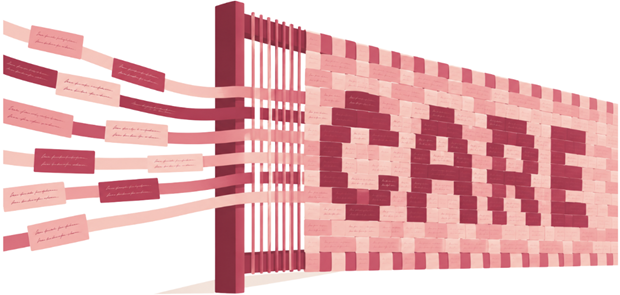
Chris thinks of Indicaretor through the metaphor that “if there's a loom and you're watching them weave on the loom with the stories, every thread is vital to the overall fabric. Each individual story matters, but together they can tell you something much larger. And you want to ensure that the finished cloth is as strong as it can be to combining those really strong threads and eliminating issues, those broken threads.”
Although Indicaretor is not yet available for commercial use, this discussion had me thinking about our traditional feedback mechanisms. Surveys, and to some extent PREMs, immediately come to mind. We know they are very good at producing numerical data, and their usefulness for measurement and comparison is well established in healthcare, but they exist entirely – and, almost archaically - within that layer. With these quantitative feedback mechanisms, we can certainly access the data, but the story behind the data is often lost to us.
Yet, if we could utilise a mature system such as Indicaretor - one where both that story, with all its detail and depth, and the data points can coexist - I wonder what sort of healthcare system we could create?
As technology advances and gives rise to programs such as Indicaretor, with AI and NLP rapidly increasing in usability, it could be argued that we are on the eve of a new feedback system that may transform healthcare epistemology - the way knowledge in healthcare is created and understood - itself.
Can we envisage a healthcare system in which quantitative feedback is derived from patient stories, rather than collected separately? A system in which feedback moves beyond the need for standardised measurement, where the data can be grasped beyond the walls of text, even though it is built from the very bricks of each story. Might we finally realise a feedback system that is truly patient-centred?
When it comes to safety and quality, decisions would no longer be derived from a number on a scale or a box ticked in a pre-designed survey. Instead, they would arise from the very words and sentences of the patients and consumers who experience healthcare.
In the coming years, could we expect systems as advanced as Indicaretor to completely erode the need for patients to perform the data mining themselves by ticking boxes or rating their experiences on a scale. Instead, we will have the richness and robustness of stories from which that quantitative knowledge can be easily pulled.
And perhaps it is time we got with the program.
To learn more about Chris’s project and Indicaretor, you can e-mail Chris at c.hawthorne@qub.ac.uk.
Indicating care: using AI to visualise patient stories
Indicating care: using AI to visualise patient stories https://www.careopinion.org.au/resources/blog-resources/1-images/80e75c6429c648009353994d13cc71d7.png Care Opinion Australia +617 3354 4525 https://www.careopinion.org.au /content/au/logos/co-header-logo-2020-default.pngUpdate from Care Opinion Australia
Posted by Ellen McGovern-Greco, Moderation and Reporting Officer, Care Opinion Australia, on







Thanks for your feedback.