

You can read the full Alpine Health case study: here
Recently, Care Opinion sat down with Alpine Health to discuss their journey using narrative, transparent feedback through Care Opinion. Here’s what we learned from our conversation.
Building on strong foundations
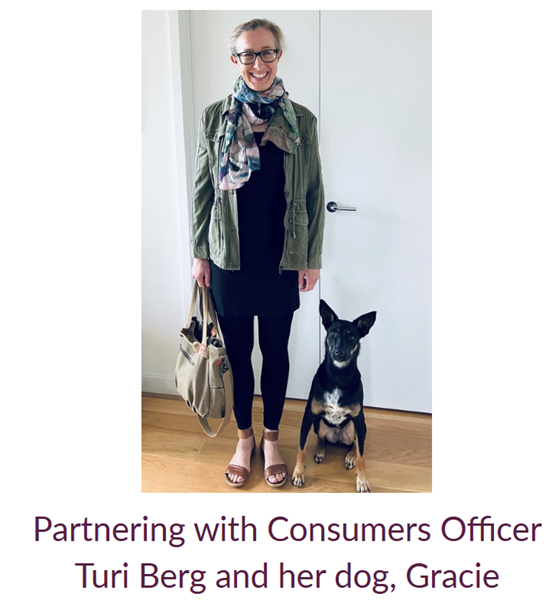
When I speak with Turi Berg, Partnering with Consumers Officer at Alpine Health, it is immediately clear that the organisation has long placed value on listening to its community. Before joining a Care Opinion project in Victoria, Alpine Health already had thoughtful processes in place to encourage feedback, from surveys and post-discharge forms to letters inviting people to share their experiences.
“Before we got invited to participate in the Care Opinion project that was running in Victoria, we'd actually had a meeting with some of our staff and our consumers,” Turi tells me. “We were talking about how we gather feedback, because traditionally, we've had either more quantitative surveys that might have an open field at the bottom, or we had basic feedback fact sheets and didn't really have that much capacity to analyse the data we got.”
Those early systems were valuable in starting a culture of listening. “We were already posting out a letter, feedback form and reply-paid envelope to all post-discharge patients saying we value feedback and would love to hear about their care experience,” Turi explains. “We were trying to encourage feedback, and we were getting quite a lot of feedback, but it was just very one dimensional.”
For Fiona MacP
hee, Director of Safety and Quality, this evolution has been striking. “Prior to its implementation, feedback had very little profile as a data source,” she says. “Care Opinion drove the organisation toward the recognition of the importance of patient experience of the care provided.”
Together, their reflections paint a picture of a health service that already valued feedback but has since found new depth and connection through narrative storytelling. As Turi puts it, Care Opinion “just elevated it to a higher level of sophistication.”
Finding meaning in stories
When Turi describes the difference Care Opinion has made, she returns to one theme repeatedly: meaning. While surveys have always offered valuable insights, the most striking feedback often came from the open-ended sections where patients could explain their experiences in their own words. “Whenever we looked at the survey responses, the most meaningful stuff we were getting was in the open comment box,” she says. “Because we’re a small rural health service, the numbers are often low, so you just don’t get the statistical power you need from survey data.”
She continues, “With Care Opinion, you get about a better picture of someone’s experience…because in those quantitative surveys, the little field at the bottom, you might only have 50 characters that you’re allowed to put in.”
Fiona echoes this, emphasising the emotional insight that stories bring. “It is hard to quantify the effect of qualitative data,” she says, “but providing a narrative with emotional and relational impacts reinforces the impact of things that go wrong for patients and their family, and as fellow human beings it is easier to relate to it.”
Those fuller narratives have since become key learning tools for Alpine Health. “We’re going to start talking about those more routinely,” Turi explains, “looking at those pieces of feedback and saying, well, how does this help meet the various national standards that we need to meet and the Charter of Healthcare Rights?”
She recalls one story in particular. “There was one a few years ago which prompted improvement work… a patient had shared that their gender diversity wasn’t captured on the forms. We were aware that some forms were outdated but competing priorities had delayed updates. Hearing directly how this affected a patient’s experience made it clear – we needed to make this change.” (You can read this story here: https://www.careopinion.org.au/91034 )
Creatin
g space for interaction
For Turi, one of the most valuable aspects of Care Opinion is the interaction it enables. “You become really timely, really accountable and really responsive,” she says. “For small communities like ours, the independence and confidentiality that Care Opinion provides means that the community members are safe to provide that feedback.”
That sense of safety has been supported by the work of Alpine’s Consumer Advisory Committee CAC. A CAC member shared “I have been able to highlight the Care Opinion form to community when they have had a problem with services…I said they could do this anonymously and give their feedback…They were very happy for me to fill in the Care Opinion form in their words.”
Turi adds that the ability for the platform to enable back-and-forth conversation is also something new. “There was actually a bit of back and forth, like three or four times in some stories,” she says. “You wouldn’t get that otherwise… so I think patients must be feeling more heard…their feedback doesn’t just disappear down the rabbit hole, we are accountable to it, and they will get a response.”
Fiona agrees that this visibility has changed the relationship between service and community. “Having every response to feedback publicly available and being able to see where we have acted on feedback encourages more of the same,” she says.
From feedback to learning
For both Fiona and Turi, Care Opinion has transformed feedback into a continuous learning process. “We share our stories with staff and the Board of Directors through regular reporting, the staff intranet, and at the unit level,” Fiona explains. “They are also included in annual reports alongside quantitative data. We use it to reinforce good or great care with staff and to show that we respond to negative feedback constructively.”
Turi adds that this culture of reflection now extends beyond the individual story. “Those really in-depth stories show the whole picture of their care where you wouldn’t otherwise get it,” she says. “Having narrative feedback to complement our audits, it’s saying that this feedback is important, and if there is something impacting their care then we want to know so that we can do better.”
Fiona sees this as part of a broader shift in mindset. “Formal complaints have remained about the same in volume, but the Care Opinion stories outnumber the complaints,” she says. “Giving people the opportunity and encouragement to share their experience publicly is significant to their sense of empowerment. Care Opinion drove the organisation toward the recognition of the importance of patient experience.”
The bigger picture
The Alpine Health case study, Seeing the Person Behind the Data (Alpine Health Case Study FIN.pdf ), highlights how Care Opinion has become embedded across the organisation’s three campuses across Bright, Myrtleford, and Mount Beauty. Stories are now discussed in meetings, displayed on staff noticeboards, and shared with the community through the Your Feedback Matters flyer.
The accompanying poster, Care Opinion Australia and Alpine Health Poster_ACVBHC.pdf visually captures this shift, showing how Alpine Health has moved from collecting feedback to cultivating dialogue, and from data to connection.
Together, they reveal a simple truth: that meaning and improvement emerge when services listen to the people behind the numbers.
Images courtesy of Alpine Health
Seeing the person behind the data: Alpine Health’s story
Seeing the person behind the data: Alpine Health’s story https://www.careopinion.org.au/resources/blog-resources/1-images/32f2846811824fb3bf7602b914ec3bb4.png Care Opinion Australia +617 3354 4525 https://www.careopinion.org.au /content/au/logos/co-header-logo-2020-default.pngUpdate from Care Opinion Australia
Posted by Ellen McGovern-Greco, Moderation and Reporting Officer, Care Opinion Australia, on





Thanks for your feedback.