

During my time at Care Opinion, one of the questions we've often been asked is how we should respond to an anonymous story when we actually know who the author is.
Historically, our advice was to treat the author with that anonymity. However, in recent years we've actually changed this advice because we realised it could be quite frustrating for patients. They've gone to the effort of telling their story. Perhaps they've even met with staff at the hospital about it or raised it through internal channels. Then, when they receive a response on Care Opinion, it's written as though nobody knows who they are - even if the person responding has already been in conversation with them.
Since then, we've changed our approach. We now say that if you know who this person is - or you genuinely believe you know who they are - then you can, and should, acknowledge that in your response.
So let's look at why.
When you identify a patient, you're treating them authentically and as a person. You're showing them that they matter, that you remember who they are, and this creates a sense of consistency and continuity in the communication.
Let's look at some examples.
We'll start with some of the more positive, or lower-criticality, stories.
Take this story: https://www.careopinion.org.au/97779 This story is about a father who passed away, and Kellie clearly knows exactly who this family are. She refers to their father as "a lovely, intelligent, articulate gentleman..." and remembers the conversations they shared. The response feels deeply compassionate and genuine because she's writing to people she knows, not to an anonymous author.
The same is true in this example: https://www.careopinion.org.au/100950 Louise begins by referring to the author's birth before mentioning a conversation they had earlier that morning. Again, she's clearly identifying the author, letting them know they were remembered.
The same applies in this story: https://www.careopinion.org.au/95296 Not only do they make it clear they know which patient they're responding to, but they also explain what occurred and provide context around the care that was delivered. Again, they're writing to the person, not to an anonymous username.
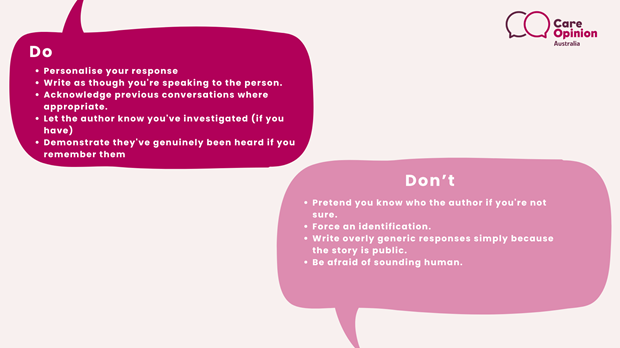
When you know who someone is, don't be afraid to write to them as a person. It makes your response feel more authentic, more compassionate, and ultimately more meaningful for the person reading it.
Things become a little more nuanced with higher-criticality stories.
This story is a Crit 5 and essentially links the author's father's death to a lack of care in hospital, so it's a very serious story: https://www.careopinion.org.au/76330. Jan, however, handles it beautifully. She acknowledges the seriousness of the story and invites the author to contact her. When they don't, she posts a second response explaining that they've reviewed patient presentations but haven't been able to identify a situation that matches the story.
This works well for two reasons. Firstly, it lifts the curtain on what has happened behind the scenes, showing that the organisation has genuinely investigated the concerns. Secondly, it's transparent about the fact that they can’t locate any presentations that sounds similar to the story. This is perfectly appropriate - it's honest, transparent and good practice to utilise in our own responses.
You'll also see authors being identified in many other stories, including: https://www.careopinion.org.au/105886
https://www.careopinion.org.au/86102
https://www.careopinion.org.au/89786
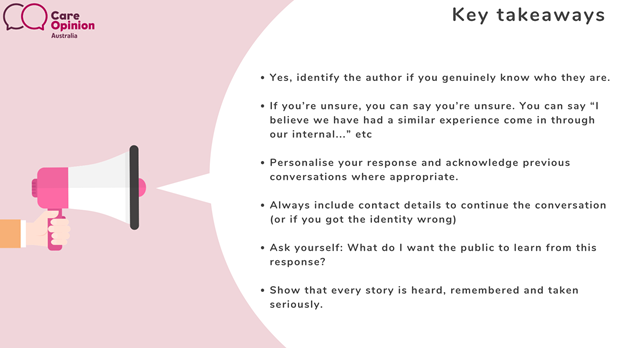
As key takeaways, if you genuinely know who the author is, don't be afraid to acknowledge that in your response. Some of the most meaningful responses on Care Opinion do exactly that. And if you think you know who someone is, it's perfectly reasonable to say, "I believe I have spoken to you before/ I believe you have spoken with our CLO…" rather than making assumptions.
Most importantly, remember that there are always two audiences reading your response: the author and the public.
By acknowledging someone where appropriate, you're showing that their story has been taken seriously. It reminds both the author and the public that this is a conversation between people. Care Opinion isn't about responding to stories. It's about responding to people. And wherever possible, we should remember the people behind the stories.
Please provide feedback for the webinar here: Rapid Response Training – Fill out form
Watch the full webinar below:
Can You Identify a Patient in a Response If You Know Who They Are?
Can You Identify a Patient in a Response If You Know Who They Are? https://www.careopinion.org.au/resources/blog-resources/0-images/3772666cc5c34501873710d036720075.png Care Opinion Australia +617 3354 4525 https://www.careopinion.org.au /content/au/logos/co-header-logo-2020-default.pngUpdate from Care Opinion Australia
Posted by Ellen McGovern-Greco, Moderation and Reporting Officer, Care Opinion Australia, on
Thanks for your feedback.