

How can we make the most of a patient story? Or perhaps a better question is: when has a story truly been made the most of?
This is an interesting question because we often assume that stories only create meaningful impact when they lead to a tangible change. However, by understanding the different pathways that stories can take, we can begin to appreciate the unique value that each pathway offers.
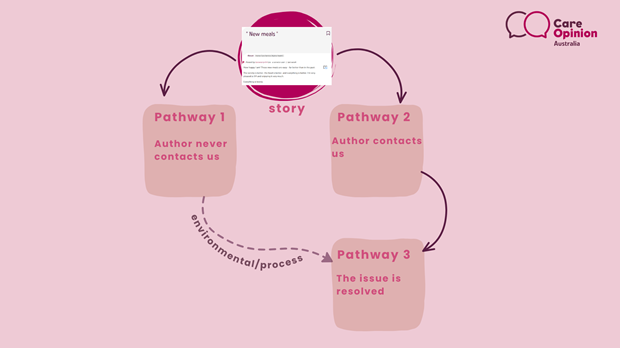
Broadly speaking, there are three pathways of impact. The first pathway occurs when a patient shares their experience and receives a response, but no further contact follows. The second pathway occurs when the patient contacts the service offline. The third pathway is when that offline engagement ultimately leads to the issue being resolved and learning or improvement being shared.
Pathway 2 is perhaps the easiest pathway from which to create change. The author contacts the service offline, allowing staff to investigate the details, better understand the circumstances, and work towards a resolution. Importantly, this can then be communicated publicly on Care Opinion so that both the author and future readers know that the feedback has been acted upon. A good example can be seen here: https://www.careopinion.org.au/104883.
Pathway 3 is, understandably, where every service hopes to arrive. It represents not only resolution but also visible improvement. The issue has been resolved - but the work does not stop there. Rather than simply responding that we are in contact with the author, we can return to Care Opinion and explain exactly what has changed because of their story. There is an excellent example of this here: https://www.careopinion.org.au/96070.
It is important to note, however, that this pathway can sometimes be reached without the author ever contacting the service offline (as seen in the dotted line). As we discussed in our anonymity webinar, stories about environmental issues or service processes can often be acted upon immediately. We can see this in this Care Opinion story: https://www.careopinion.org.au/85072.
Returning now to Pathway 1, this is arguably the most challenging pathway. We respond, but we never hear back from the author. As a service, this can be difficult to navigate. It is easy to think, well, what was the point? If we can't investigate further and can't resolve the issue, what then?
But perhaps there is still a point after all.
For every story, we should ask ourselves: What can we learn from this? Of course, it is wonderful when an author chooses to engage further and a story progresses all the way to Pathway 3. But that is not the only measure of success.
Instead, ask yourself: How does this story make me feel? Has it changed anything within me? Will I remember it? Has it helped me better understand what it is like to be in someone else's shoes?
This is how every story, regardless of its pathway, has the potential to create impact. Stories change us. They influence us in ways that data alone often cannot. They encourage reflection and inherently deepen our understanding of the experiences of those in our healthcare system.
While preparing this webinar, I was reminded of a theory I studied during my philosophy degree called affect theory. Broadly speaking, affect theory is interested in how experiences continue to shape us. Rather than seeing encounters as isolated events, thinkers such as Karen Barad argue that we are continually formed through our relationships and experiences with others. Barad refers to this as intra-action, (read more here: https://muse.jhu.edu/book/70496).
I could not help but think that Care Opinion stories work in much the same way.
The more we read patient stories and the more we encounter experiences we may never have lived ourselves – then the more these stories shape how we think and relate to others. I think this is one of the central strengths of Care Opinion: the invitation to let yourself be moved by these stories; to let them affect you, impact you, intra-act with you and change the way you see and engage with the world.
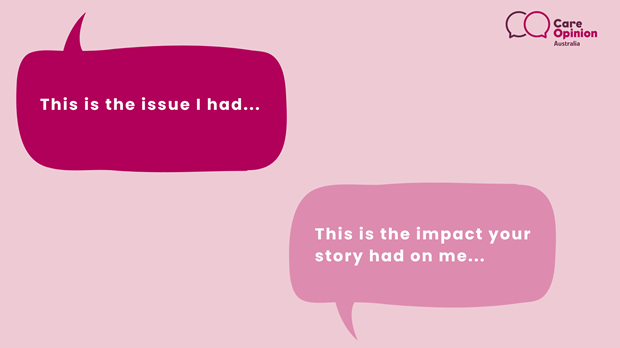
And finally, you can acknowledge this in your responses. You can tell an author that their story affected you, that it showed you a perspective you had not previously considered, or that it has changed the way you think about a particular experience. Sometimes it is enough for someone to know that their experience has had an effect, that they have been heard, that someone has been witness to their experiences.
So let yourself be impacted. Let yourself step into someone else's shoes. What will you learn? And finally, don't be afraid to write about it in your responses.
Please provide feedback for the webinar here: Rapid Response Training – Fill out form
Watch the full webinar below:
What Happens After the Story Is Published and Responded to?
What Happens After the Story Is Published and Responded to? https://www.careopinion.org.au/resources/blog-resources/1-images/62a4ad4226da401eb3a1558d37361912.png Care Opinion Australia +617 3354 4525 https://www.careopinion.org.au /content/au/logos/co-header-logo-2020-default.pngUpdate from Care Opinion Australia
Posted by Ellen McGovern-Greco, Moderation and Reporting Officer, Care Opinion Australia, on
Thanks for your feedback.